When an External BI Team Makes More Sense Than Hiring In-House
One analyst, an external BI team and an internal data function solve different problems. Choose by workload, required capabilities and ownership—not by day rate alone.
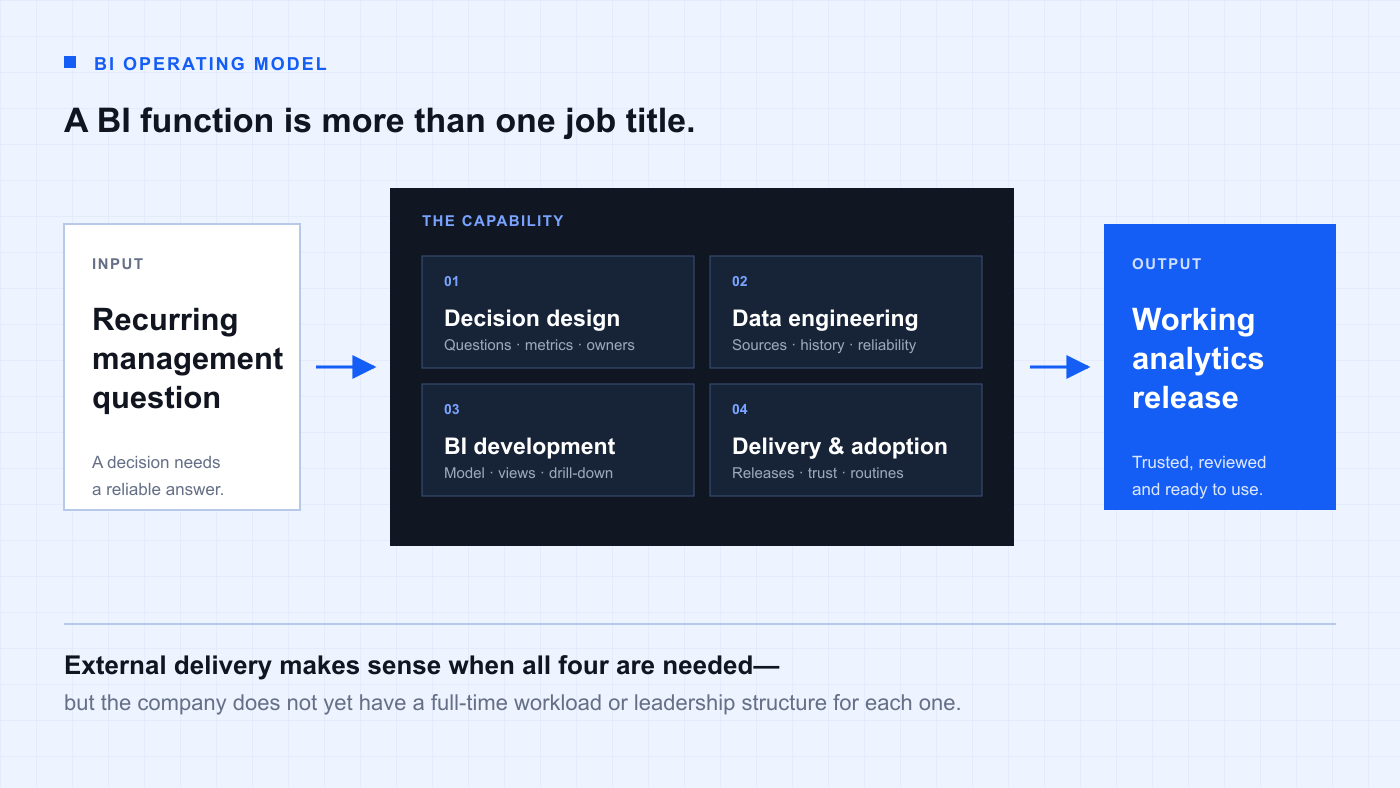
A useful BI release usually crosses four kinds of work. An external team is valuable when all four are needed, but the workload does not yet justify four permanent roles.
A common comparison starts in the wrong place
The choice is often framed as one internal analyst versus one consulting contract. That looks like a clean salary-versus-fee calculation, but it compares a job title with an operating capability. The visible request may be a dashboard, but the delivery capability behind it spans several distinct kinds of work.
A strong generalist can cover several of those areas, especially at the beginning. The risk appears when the same person becomes the owner of every definition, every failed load, every new view and every conversation with users. The company has hired an analyst, yet still has a single queue and a single point of failure.
The useful question is therefore not “Which option has the lower monthly price?” It is “What BI capability do we need over the next 12 months, how much sustained work exists for each capability, and who inside the company will own the decisions?”
A working BI function combines several capabilities
Team names vary, and one experienced person may cover more than one role. The responsibilities still exist even when the organisation does not name them separately.
- 01
Decision and metric design
Translate a management question into definitions, dimensions, thresholds and a review routine. This requires access to business owners, not only to databases.
- 02
Data engineering
Extract data from CRM, ERP, finance, product or operational systems; preserve history; monitor loads; and keep transformations reproducible.
- 03
BI development
Build a model and interface that show the result, its drivers and the records behind a suspicious number without creating conflicting calculations.
- 04
Delivery and adoption
Set release boundaries, reconcile the result with users, train them on real decisions and make the dashboard part of a recurring management review cycle.
When an external BI team is the better fit
An external team makes the most sense between ad-hoc reporting and a mature internal data function. The business already has recurring questions and multiple systems, but the workload is often uneven: intensive integration and modelling at the start, followed by ongoing, lower-intensity cycles of development, support and adoption.
The case becomes stronger when several of the following conditions are true:
- Leaders need a working first release in months, while recruiting and assembling a balanced internal team would take longer.
- The first scope crosses business analysis, data pipelines, modelling and dashboard delivery, but none of those disciplines has a full-time backlog on its own.
- Reports depend on several sources and departments that currently use different definitions of customer, order, revenue, margin or completion.
- The internal team can provide source owners and a decision owner, but cannot yet design and run the entire BI delivery process.
- The company wants to validate the architecture, actual backlog and management routine before committing to permanent headcount.
- Continuity matters more than access to one heroic generalist: code, definitions and support must survive an individual’s absence or departure.
When building in-house is the better decision
External delivery is not a permanent answer for every company. An internal data team becomes more attractive when analytics is a daily product capability rather than a sequence of bounded management releases.
An external team also adds coordination and access overhead: it starts with less business context, may not match the response time of an embedded employee and must be governed carefully where data access is sensitive. If those costs are continuous rather than temporary, in-house may be the better model.
Building in-house is usually the stronger choice when:
- There is a continuous, prioritised backlog large enough to occupy the core roles every week.
- Data work is tightly coupled to product development and requires daily decisions with engineering, security or domain teams.
- The business has an experienced data or analytics leader who can set standards, recruit specialists and judge the quality of the work.
- Critical context cannot be transferred efficiently and must accumulate inside the company over years.
- Regulation, security or customer commitments require operating controls that an external arrangement cannot meet economically.
- The company is ready to own not only dashboards, but hiring, management, cover for absences, platform reliability and professional development.
The hybrid model is often a transition, not a compromise
Many companies do not need to choose a permanent side on day one. An external team can establish the first data model, delivery rhythm and quality checks while an internal owner learns the system. Once the backlog and required roles become visible, the company can hire deliberately instead of guessing at an org chart before the work exists.
Design that transition from the start. Client-side owners should take part in reconciliations and release reviews rather than receive a finished black box at the end.
- Prove
- Standardise
- Document
- Hire
- Transfer
- Support
What the company must still own
No external BI team can decide what revenue means for the board, force managers to enter missing data or choose which operating problem deserves attention. Those are management responsibilities. Outsourcing them creates a polished dependency rather than a useful system.
A workable engagement has an internal decision owner with enough authority to settle definitions, provide access to source owners, review releases and change a meeting or process when the evidence requires it. The external team can structure the conversation and expose inconsistencies; it cannot replace internal authority.
This division is also the basis of a safe handover. The engagement should state who controls the data, cloud accounts, repositories, code, credentials and metric definitions, and what will be transferred on exit. The delivery team remains accountable for the quality and transparency of its work.
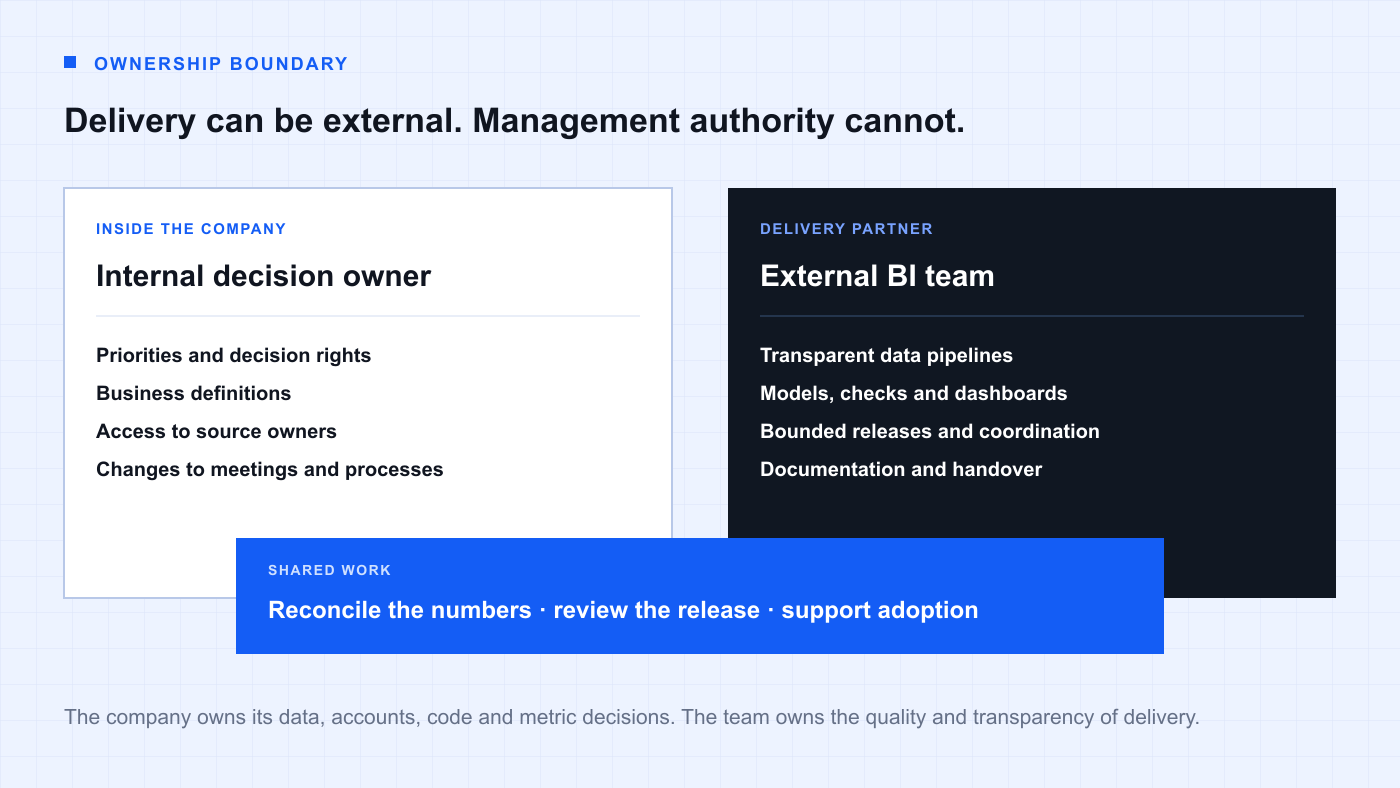
The company keeps authority over priorities, definitions and decisions. The external team owns an explicit delivery system. Validation and adoption are shared work.
Compare the operating model, not only the rate
Day rates and salaries matter, but neither describes the full cost of obtaining a reliable answer. Compare the alternatives against the same 12-month scope and include the work that is easy to omit from a headline price.
- Time until the first decision-ready release, including recruitment, onboarding and source access.
- Coverage of the capabilities the scope actually requires—not the number of people on a proposal or org chart.
- Management time needed to coordinate specialists, settle definitions and review delivery.
- Continuity when a key person is unavailable and the cost of replacing lost context.
- Ownership of repositories, infrastructure, documentation, credentials and reusable data models.
- The cost of changing direction, reducing scope or transferring the system later—and how reversible each option is.
Red flags in an external BI arrangement
An external team reduces hiring risk only if its own delivery model is transparent. Be cautious when the arrangement depends on opacity or endless task intake.
- 01
The proposal starts with a list of dashboards
There is no named decision, user, review moment or acceptance criterion behind the screens.
- 02
The client cannot inspect the foundations
Definitions, transformations, repositories and accounts remain with the supplier, making verification and exit unnecessarily difficult.
- 03
Every request becomes an isolated ticket
The backlog grows without a product owner, a release boundary or a coherent data model, so the system fragments over time.
- 04
Handover is promised only at the end
Internal users and technical owners are not involved in reviews, so knowledge transfer becomes a rescue project instead of a normal transition.
Start with a bounded first release before committing to ongoing support
A lower-risk first step is a bounded release around one recurring management question. Name the decision, the users, the relevant sources, the smallest useful output, the reconciliation method and the expected review date. This is enough to test how the external team works without pretending the entire analytics roadmap is already known.
At the end of the release, evaluate both the system and the operating model. Did the team make definitions explicit, expose its work, respect the agreed ownership and leave the client able to continue or transfer the system? The answers indicate whether to continue externally, begin a hybrid transfer or build the next capability in-house.
The right choice can change as the company grows. Good BI architecture should make that change easier, not lock the business into the organisation that built the first dashboard.